2026-07-13 · 13 min
How to Learn Moroccan Amazigh as a Beginner
Learn how to start learning Moroccan Amazigh and understand the differences between Tamazight, Tachelhit, Tarifit, Berber and Shilha.
Learning Moroccan Amazigh is possible when you start with listening, useful everyday phrases and a regular routine. Before choosing a method, though, you need to clarify one important question: which Amazigh variety do you actually want to learn?
In Morocco, Amazigh languages are not one perfectly uniform block. Depending on regions and families, you may hear Tachelhit, Tarifit, Central Moroccan Tamazight or more standardized uses of the word Tamazight. If your goal is to speak with family, reconnect with a region or prepare for life in Morocco, that distinction matters.
This guide helps you understand the main terms, choose a variety carefully and start in a practical way, without turning the subject into a technical linguistics course.
Quick answer
To learn Moroccan Amazigh, start by identifying the variety that matches your goal. If your family comes from the Souss or southern Morocco, Tachelhit may be the most relevant direction. If your family comes from the Rif, look at Tarifit or Rifian. If your connection is with the Middle Atlas or central Morocco, Tamazight may refer to another regional reality.
Then prioritize audio. A living language is first learned by ear: rhythm, intonation, sounds, repetition and complete phrases. Writing can come gradually, but it should not block your first attempts to understand and speak.
Finally, begin with simple situations: greeting people, introducing yourself, talking about family, asking someone to repeat, and recognizing words linked to home, food or travel. A few regular minutes are more useful than one long occasional session.
Amazigh, Tamazight and Berber: what is the difference?
Amazigh is the term to prefer when referring to Amazigh languages, cultures and peoples. In the plural, you may also see Imazighen for Amazigh populations.
Tamazight is more context-dependent. It can refer to the Amazigh language in a broad sense, to standardized Moroccan Amazigh, or to a regional variety, especially in central Morocco. When a course says “Tamazight”, check what it actually teaches.
Berber is still widely searched in English. Many learners type “learn Moroccan Berber” because that is the term they know. It is understood, but Morolingo uses Amazigh, which is closer to current cultural and educational usage in Morocco.
These words should not be treated as perfect synonyms. For learning, the practical question is simple: which language do the people you want to speak with actually use?
Which Amazigh languages are spoken in Morocco?
Morocco has a rich linguistic landscape. Darija is very present in everyday life, but Amazigh languages are also important depending on regions, families and contexts.
Do not imagine one single Amazigh language spoken identically everywhere. Varieties may share elements, but they also have their own sounds, words, habits and regional anchors.
Tachelhit in the Souss and southern Morocco
Tachelhit, sometimes called Shilha in English, is an Amazigh variety strongly associated with the Souss, the Anti-Atlas, parts of the High Atlas and southwestern Morocco.
The word Shilha can refer to the language or its speakers depending on context. Use it carefully and keep in mind that learners will often see both names, Tachelhit and Shilha, for roughly the same regional family.
If your family comes from the Souss or a southern Moroccan area where this variety is present, Tachelhit is often a logical place to start.
Tarifit or Rifian in the Rif
Tarifit, also written Tarifiyt and often called Rifian, is mainly associated with the Rif and northern Morocco. Many people who search for the “language of the Rif” are looking for this variety.
If your goal is to communicate with a family from the Rif, do not assume that a Tachelhit-focused resource will automatically fit. Amazigh varieties are not interchangeable for every family or regional goal.
Central Moroccan Tamazight
Tamazight can also refer to a variety associated with central Morocco and the Middle Atlas. This is one reason the term can be confusing for beginners.
When you see a course for “Moroccan Tamazight”, check whether it follows a standardized approach, a Central Moroccan variety or a broader use of the word Amazigh.
Which Amazigh variety should you learn?
The best choice depends on your goal. If you want to speak with parents or grandparents, start from their region and the language they actually use. If you are preparing a trip, ask which language is most present where you are going. If you want to reconnect with family history, ask the people concerned before choosing a resource.
A simple guide can help:
- family from the Souss or southern Morocco: look into Tachelhit;
- family from the Rif: look into Tarifit or Rifian;
- links with the Middle Atlas or central Morocco: look into local Tamazight;
- school or institutional goal: distinguish standardized Moroccan Amazigh from regional uses;
- broad cultural goal: understand the differences before choosing a method.
These are cautious pointers. Linguistic borders are not always neat, and many families have mixed histories. The most reliable option is to ask speakers what name they use for their language.
Are Tachelhit, Shilha and the language of the Souss the same?
In many English contexts, Shilha refers to Tachelhit or to its speakers. “Language of the Souss” is also used as a geographic description.
The clearer linguistic term is Tachelhit. Shilha is common in English, but its use depends on context and the speaker. For learning, avoid shortcuts: if someone says they speak Shilha, ask which region their family comes from and whether they mean Tachelhit.
This helps you choose a resource that matches your real goal instead of learning a variety that does not fit the people you want to speak with.
Can you learn Amazigh without learning Tifinagh?
Yes, you can start speaking without mastering Tifinagh. For a beginner, audio, repetition and useful phrases are often the priority.
Tifinagh matters if you want to read written content, understand standardized Amazigh or recognize the official script. It can become useful for school, signs, institutional materials or a more complete approach to the language.
But you do not need to wait until you can read perfectly before listening and repeating. If your priority is family conversation or a few practical situations, start with the oral language and add writing gradually.
How to start learning Moroccan Amazigh
A good method should be simple, regular and adapted to your goal. It should also respect the variety you want to learn.
Choose one variety at the beginning
Avoid mixing Tachelhit, Tarifit and Tamazight in the first weeks. Even when varieties are related, beginners need stable points of reference. Choosing one variety makes sounds, phrases and habits easier to remember.
Listen from day one
Moroccan Amazigh is learned with the ear. Transcriptions can help, but they do not replace listening. Pronunciation, rhythm and sounds need to be heard several times before they feel natural.
Learn complete phrases
Complete phrases are more useful than isolated words. They show you how to speak in a real situation: greeting, asking, answering, thanking, saying that you do not understand or asking someone to repeat.
Repeat out loud
Silent repetition does not help speaking very much. Even alone, repeat out loud. It helps with sounds, confidence and the first signs of speech memory.
Work with everyday situations
Start with what you can actually use: family, home, food, transport, greetings, politeness, shopping and simple needs. A language becomes easier when each phrase is tied to a concrete scene.
Practise with family or speakers
If you have access to speakers, use very short phrases and ask for corrections. Even a few words in a family conversation can help you remember more quickly.
Review regularly
Regularity matters more than duration. Ten minutes a day can be more effective than one large weekly session. Review the same phrases several times, then gradually add new situations.
Which first situations should you learn?
At the beginning, do not try to cover the whole language. Choose the most frequent and useful scenes.
Useful first situations include:
- greetings;
- introducing yourself;
- family;
- politeness;
- food;
- shopping;
- transport;
- home;
- numbers;
- simple needs;
- asking someone to repeat;
- saying that you do not understand.
This approach avoids turning learning into a dictionary. You build an oral base around moments that can really happen.
If you also want a method that transfers from Darija learning, our guide to learning Darija as a beginner explains why real situations help beginners so much.
How long does it take to learn Amazigh?
There is no universal duration. A few weeks may be enough to remember greetings, frequent words and simple phrases. Holding a conversation requires more listening, practice and correction.
Understanding different speakers often takes longer, especially when accents, regions or family uses vary. Someone who grew up hearing the language may progress faster than a complete beginner because some sounds and words already feel familiar.
Regularity remains the most important factor. It is better to listen and repeat a little every day than to try to learn everything at once.
Can you learn Amazigh without living in Morocco?
Yes, but you need to create exposure. You can listen to audio dialogues, watch videos, ask family members for voice messages, join calls, repeat short phrases or look for speaker communities.
An app can structure your routine, but it does not fully replace human exchanges. To progress orally, you need to hear several voices, try your phrases and accept corrections.
If you do not live in Morocco, set a simple goal: one phrase to recognize, one phrase to repeat, then one phrase to use in a voice message or call.
Common beginner mistakes
Beginners often slow themselves down by going too broad or choosing a poorly matched resource.
Common mistakes include:
- learning a variety without checking whether it matches your family;
- mixing Tachelhit, Tarifit and Tamazight from the start;
- learning only isolated words;
- neglecting pronunciation;
- focusing only on writing;
- waiting until you are perfect before speaking;
- using a resource without knowing which variety it teaches;
- thinking all speakers use exactly the same words.
These mistakes are normal. The key is to return to a simple method: one variety, short phrases, audio, repetition and real exchanges.
How Morolingo helps you discover Amazigh
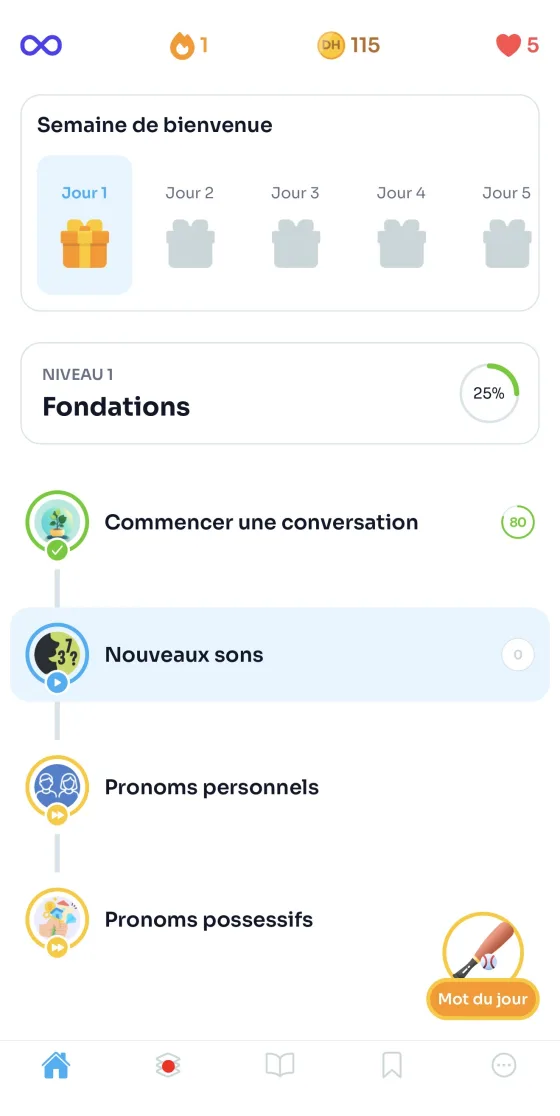
Morolingo lets you learn either Moroccan Darija or Amazigh in the same app. When you first install the app, you choose the language you want to study, and you can later switch languages in the settings to vary your learning.
For Amazigh, the app offers a beginner-friendly progression with audio dialogues, vocabulary, quizzes, short exercises and everyday situations.
As Amazigh includes several regional varieties and usages in Morocco, always check that the content matches your family, region or specific language goal.
Useful resources for further learning
- Download Morolingo on iOS or Android
- Learn Amazigh with Morolingo
- Discover Morolingo in English
- Darija or Classical Arabic: which one should you learn?
- Learn Darija as a beginner
- Learn Darija fast with a realistic routine
These resources do not replace choosing the right Amazigh variety, but they can help you structure your learning and keep a regular routine.
Frequently asked questions about learning Amazigh
Are Amazigh and Tamazight the same thing?
Not always. Amazigh is a general term. Tamazight can refer to the Amazigh language broadly, standardized Moroccan Amazigh or a regional variety, especially in central Morocco. Context matters.
What is the difference between Tachelhit, Tamazight and Tarifit?
Tachelhit is strongly associated with the Souss and southern Morocco. Tarifit, or Rifian, is associated with the Rif and northern Morocco. Tamazight can refer to a central Moroccan variety or a broader use depending on context.
Which Amazigh language is spoken in the Souss?
The Souss is strongly associated with Tachelhit. In English, you may also see Shilha, but Tachelhit is usually the more precise linguistic term.
Which Amazigh language is spoken in the Rif?
In the Rif, people mainly speak Tarifit, also called Rifian or Tarifiyt depending on usage. It should not be confused automatically with Tachelhit from the Souss.
Are Tachelhit and Shilha the same language?
In many English contexts, Shilha refers to Tachelhit or to its speakers. Usage can vary, but for learning the language, Tachelhit is usually the more precise term.
Can you learn Amazigh without reading Tifinagh?
Yes. You can start with speaking, audio and useful phrases. Tifinagh becomes important if you want to read written content or go deeper into standardized Amazigh.
Can you learn Amazigh with Morolingo?
Yes. Morolingo lets you choose between Moroccan Darija and Amazigh when you first install the app. You can then switch languages in the settings to vary your learning.
Can you learn Amazigh on your own?
You can build a foundation on your own with audio, exercises and a regular routine. To progress orally, it is still useful to practise with speakers, family members or a teacher.
Conclusion
To learn Moroccan Amazigh, start by identifying the variety that matches your family, region or goal. Amazigh is a broad term: Tachelhit, Tarifit and Tamazight can point to different uses.
Once the variety is clear, keep the method simple: listen, repeat, learn everyday phrases and practise regularly. Writing, including Tifinagh, can come gradually depending on your needs.
Morolingo lets you learn Darija or Amazigh in the same app. You choose your language on first launch, then you can change it in the settings to alternate between the two paths.